Studio Exploration - Ink pen
- Apr 16, 2025
- 5 min read
This post is to convince you to use ink pen, and if you already are using it, congratulations you are on the right team :D
Why Ink pen?
Not only is it a very versatile tool that students often have on them, people of all ages and fields can also tend to often find this common tool lying around just about everywhere. They can be as cheap or expensive as one needs, depending on one's need. Additionally, ink pens are not only friendly towards its user but also where they can be used, as almost every types of paper can be drawn on, even napkins.
Ink pen also come in various different tips, small, big and different brushes, not to mention different ink types. One last big thing is ink pen do not smudge and transfer, so they are incredibly easy to control.
Materials
As mentioned above, ink pen comes in so many different sizes and types that accounting for them all will be extremely difficult. Though, due to its vast number of options, a wide range of price also exist, which means students of all ages can afford this medium. Also, with how easily applicable the pens are, I will use the same previous papers that were used, plus a more common papers often found in the local convenient shops.
Since Amazon is a worldwide shipping company, I will use its price range and without the occasional sale prices.
Micron pen (for 6) $11.99 --- $2.00 per count
Faber Castell pen (for 4) $11.50 --- $1.87 per count
Sharpie pen (for 12) $19.06 --- $1.59 per count
Tombow brush pen (for 3) $7.26 --- $2.11 per count
Strathmore Sketch paper (9x12, 50 sheets) $11.00 --- $0.22 per count
Strathmore Drawing paper (9x12. 24 sheets) $10.50 --- $0.4 per count
Canson sketch paper (9x12, 100 sheets) $19.35 --- $0.19 per count

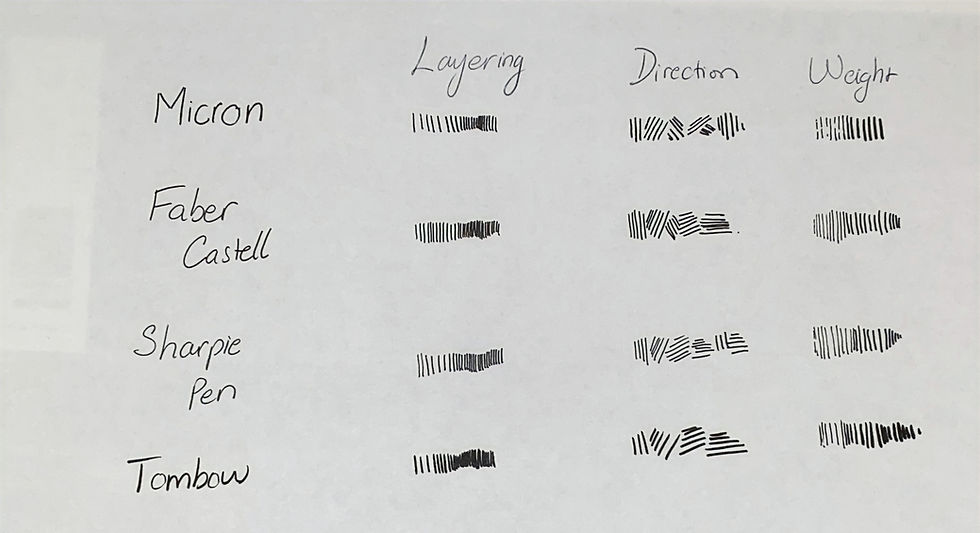
Strathmore Drawing Paper
Micron Pen
Layering is very consistent
Direction is easy to control
Weight is a bit hard to adjust due to how consistent the ink is
Can bleed through the paper a bit
Overall a 7/10
Faber Castell
Layering is great, since the pen is about .8 cm
Direction is better than Micron since it seems easier to control
Weight control is okay, not great but good enough
Overall I will give it a 8/10 due to how easy it is to control the pen
Sharpie Pen
Layering is almost identical to Faber
Direction shows a lack of control though, due to how the tip of the pen seems to want to stick to the paper surface
Weight control is much better than the other 2, since it actually leave a deep dark mark if pressed hard enough
Overall a 8/10. It is a balance give and take
Tombow brush pen
Layering is fine, not great, since the thickness of the tip is already quite large
Direction is somewhat okay, but considering it is a brush pen, the control is absolutely amazing
Weight control is perfect, does exactly what is required of it
Does bleed through a bit due to it giving a lot of ink
Overall a 9/10 for me

Strathmore Sketch Paper
Micron Pen
Layering is very consistent, though bleeding could be seen in the strokes, so closer strokes just does not look aesthetically pleasing
Direction is easy to control
Weight control is okay, needs extreme light touches
Can bleed through the paper a bit
Overall a 8/10
Faber Castell
Layering is great
Direction is better than Micron since creating consistent stroke seems a lot easier
Weight control is not enough to be considered good. Pushing it hard just does not seems to create a difference to medium pressure
Overall a 7/10 for me
Sharpie Pen
Layering is actually the best here, since the stroke does not seem to bleed at all
Direction is the same, just as good for the exact same reason
Weight control a tiny bit better than Faber Castell since I could at least felt the difference between hard and medium pressure
Overall a 7/10, quite a great choice for me
Tombow brush pen
Layering is actually surprisingly good, however it only manage to get to the level of Micron pen
Direction is somewhat okay, not great
Weight control is perfect, does exactly what is required of it (as often seen on all these different papers)
Is the most visible if looking at the paper flipped around
Drop down to a 8/10 for me due to the heavy bleeding in layering.

Canson Sketch Paper
Micron Pen
Layering is consistent, quite nice
Direction is easy to control, even with smaller mark making, you can still see the direction of it
Weight looks okay, does need extra light pressure, which can create cut up lines ... though the heavy pressure does impress me a lot
Does not damage the paper at all
Overall a 8/10
Faber Castell
Layering is great with how consistent the line work is
Direction is just as nice ... with no ink seems to be lost when sudden transitioning
Weight control is surprisingly good, with clear contrast seen between light and heavy pressure, though medium pressure is debatable
Overall I will give it a 9/10 as well
Sharpie Pen
Layering is almost identical to Faber :D
Direction is great, though the sudden change in direction needs adjustment for the ink to appear consistent
Weight control is right between the other 2 for me, since it does have great contrast, it require very very fine control
Overall a 8/10
Tombow brush pen
Layering is alright, since the paper is so thin that every mark seems to bleed over
Direction is great, as usual since it is a brush pen, changing direction does not affect its ink dispense at all
Weight control is lacking, due to heavy bleeding of the line, can seem to be too much towards the heavy pressure
Ruin the surface if pressed too hard, due to paper thickness
Overall a 6/10, sadly would not recommend with this type of paper
In Summary
Age Appropriation:
With its vast range of price, the medium is suitable for students of all ages to use. According to OSHA ( Occupational Safety and Health Administration), ink pen is not considered a physical and health risk, though the ink can have minimal toxic affect, highly recommended to not be put in young children's hand. Due to its hardness however, young children also needs to be careful while carrying and playing with pens, as it can pierce through skin if pressed hard enough. So overall perhaps it is more suitable for students in the range of middle and high school.
Strength:
very consistent
easy to access
easy to control
depending on paper, precise outcome can be controlled
cheap
Weakness:
does seem intimidating as it can not be erased
takes a bit of time to get used to, as it does not stay on paper, no friction almost
choosing the perfect pen can seem frustrating and takes a bit of time and effort as there are just so many options
Additional resources:
Artists such as Eliza Ivanova, Yusuf Kaya, Kentaro Miura and especially Rembert Montald and Kim Jung Gi are very noteworthy people to look up.
or other online videos are very helpful, such as :
https://www.youtube.com/watch?v=MGbvhyTZXfs by Super Ani
https://www.youtube.com/watch?v=KoyFjDK6GII&list=PLW-5Pa-fZ-c9u9ENT0VKOYjKuhAxnr6h9 by Drawing and Painting - the Virtual Instructor, Matt
My own example:


Comments