Collage
- Dec 5, 2025
- 5 min read
Process and product:
There are two separate projects that I tried out quickly, as a test to see how my thinking process could go.
The first one is about building a narrative piece, with imagery that could tell a deeper story, much like a Middle Age painting. The process starts off with looking through the materials, newspaper, clothing magazines, etc ... and find images that grasp my attention. Then, by choosing 2 -3 main elements, I start building a narrative around them, building up a story and choose secondary elements to support said narrative. Additionally, I had to bring into consideration texture and 3D element, since making a collage is not just about making a 2D drawing but almost like building a sculpture of paper in my opinion. The attempt at building a narrative could be seen right here and I think it is relatively successful, though it requires a lot more time and effort, with even a larger volume of resource to curate a proper story. One last thing to add is that the process will have to be started from the background into foreground, something which is going to be a challenge for students of younger ages.
The second project I tried to do is a relatively quick attempt at making a very simple landscape piece that perhaps younger students would find much easier to do. By choosing only a couple of colored paper, I set a limit on how myself, thus pushed my problem solving skills in the piece. I then outlined a very simple silhouettes of subjects that could potentially help with my piece. After cutting out the different silhouettes of the subjects, I glue them down based on a design I had in mind, thus, resulting in the piece below. The whole thing took roughly 7-10 minutes, which was very fast in my opinion. This project, if done this way, could potentially be a 1 week project, mainly aiming for students to grasp an understanding of simple elements of design like shapes and proportion.


Technical and safety information about tools and materials
The materials and tools needed for this project is extremely easy to prepare and children friendly. I would have said that scissors are dangerous for younger children, but with the new children scissors and even left handed ones, the tools have become incredibly
friendly. Otherwise, I think this type of art making process is definitely the easiest to do and one of the most easily available.
One thing to note that students can help contribute with is by bringing in different magazines and newspaper around their house. This can sometimes help the students bring a more personal touch or emotion to their own project, differing theirs from other classmates in a much more intimate way. Teachers on the other hand can prepare different papers with vastly different textures, which help the students to think about building up textures in a 3D manner.
I think the process of collaging is very self - explanatory ... with just a few key points to keep in mind and help students to be aware of like textures, composition, ... fundamentals of art.
tools and materials include:
paper
newspaper
pencil
scissors
glues
Ideas of use for preK-12
An idea I have for students of younger ages is to focus on the concept of compositing and usage of same color hue or value to create a much clearer imagery. By borrowing elements of collage, students can create a quick work of art that still be very complete and viewed as whole. Like the art piece below by artist Derek Gores, students can practice cutting and preparing pieces and cuts of suitable color schemes and easily arrange them, testing before settling down with glue.

For students in middle or high school, collaging and then bringing other mediums can be very productive and create unique pieces. The juxtaposition between collaging and other medium can create very strong impressions/feelings for the viewers. This way of doing art should be intentional and require careful planning and considerations from the artists. I really think that though this project can be less fun, it can still bring a lot of experimental value for the artist; thus, older students are definitely the recommended group to try and test out different combinations of materials.

Reading Incorporated Idea:
"Collage is about juxtaposing similar and dissonant elements together in a composition that invents its own logic/order or creates ambiguity just by the proximity of one element to another, and this sense of playing with meaning is what makes the medium so intriguing."
This metaphoric thinking is something I didn't touch on in the previous parts, though I do believe that talking about it, introducing this way of thinking to students is extremely important. It teaches not just about the making of the art, but about bringing a meaning to the form and the medium of collaging.
"Reflecting on your written observations and looking at your test pages, which collage materials and surfaces do you find most interesting? Most expressive? Most fun to work with? Most challenging? Most disappointing? Most surprising? Why?"
Reflection is almost as important as planning and executing the art projects. It provides an opportunity to seriously looking back upon the journey and trying to inspect oneself, dissect one's thought and reverse engineer a process. I think that students, especially of crafts, learn the most through reflection, which can then be used to build up resistance and awareness so as not to repeat their past mistakes.
"The fluidity of collage offers opportunities for visual puns and analogies and gives me surprising ways to think about illusion, deception and representation"
This idea combines both the thoughts of creating a narrative and juxtapose imagery senses mentioned previously, however, in a much more complete way. Sometimes, art is a little too straight forward, and limitation with one's skills can create boundaries for one to attempt at telling something with deeper meaning; but, collage provides the perfect chance because it already bypass the craftsmanship issue, as people wouldn't put that as a priority when looking at collages, but digging for a message behind the chaos.
Attempt at a lesson
The lesson was taught by me and another classmate Olivia , while planned with one other - Chen, who was unfortunately sick on the day of presentation.
Firstly, we communicated with the class about using collage as a way to portray an emotion, of any kind. We made the class participate in a quick brainstorm of coming up with different words for the 5 big emotions.

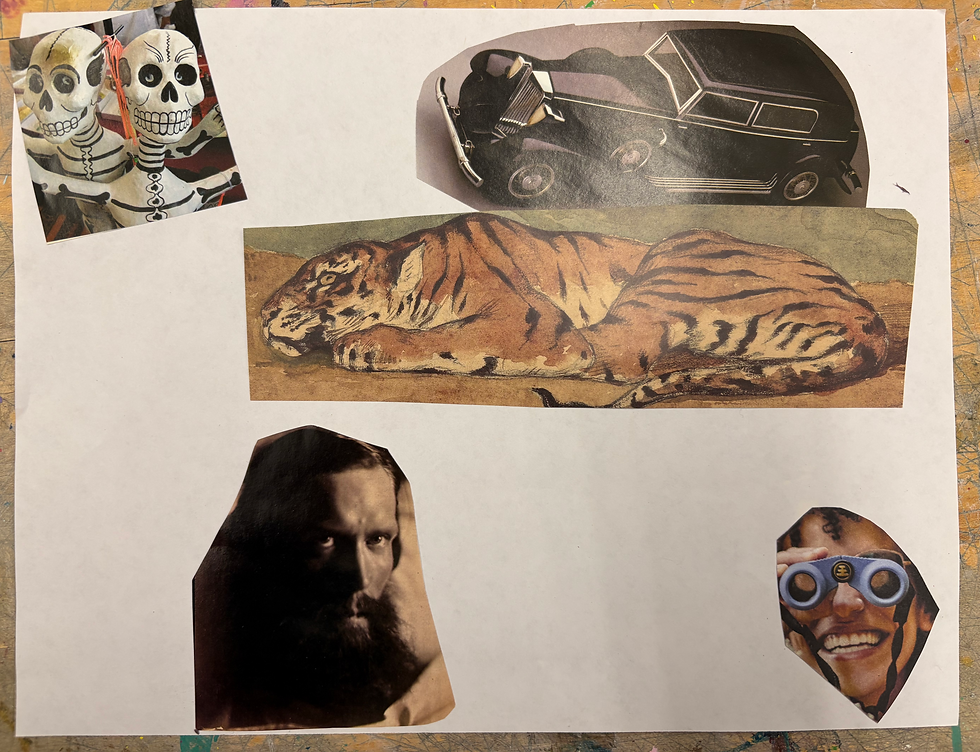
Secondly, we provided the class with an assortment of imagery and told them to pick 5 images to form a story that could potentially encompass an emotion of their choice. While the craftmanship of the project was on the lower end, the main goal of this was to spark interest and introduce them to the art of collaging with a narrative in mind.
Overall, we received very positive feedbacks and great engagement from the class. However, it is important to note that this is a very compact lesson, a minimized version of what was supposed to be a much longer and bigger project for classes of older students. I came to learn that for teachers, helping students to innovate and to make their own choices is just as important as guiding them one step at a time. By helping them generate their own themes, the neurons were fired up and the students were ready for their work the moment we finish brainstorming, helping them be more task focused and ready to engage, which helped speeding up class time and saving up time for actual work on project.



Comments